Chemical reaction worksheets, often available as PDF downloads with answer keys, are crucial tools for Grade 10 students navigating complex reaction types.
These resources enhance understanding and retention, offering practical application of synthesis, decomposition, single, double replacement, and combustion reactions.
What are Chemical Reactions?
Chemical reactions represent the fundamental processes where substances, known as reactants, transform into entirely new substances – the products. This transformation involves the rearrangement of atoms and molecules, governed by the principles of chemistry.
Understanding these reactions is vital, and worksheets, particularly those focusing on reaction types with provided answer keys, serve as excellent learning aids. These PDF resources categorize reactions into five main types: synthesis, decomposition, single replacement, double replacement, and combustion.
Successfully identifying these types, often practiced through dedicated worksheets, allows students to predict outcomes and balance chemical equations, building a strong foundation in chemistry. Mastering this skill is essential for further study in the sciences.
Why Use Worksheets for Learning?
Worksheets dedicated to chemical reaction types, often available as printable PDFs with accompanying answer keys, provide a structured approach to mastering this complex topic. They move learning beyond rote memorization, encouraging active engagement and problem-solving skills.
These resources allow students to systematically analyze reactions, categorize them correctly, and predict products – skills crucial for success in chemistry. The availability of answer keys facilitates self-assessment and identifies areas needing further attention.
Furthermore, worksheets bridge the gap between theoretical knowledge and practical application, reinforcing concepts through repeated practice. They are invaluable tools for both classroom instruction and independent study, enhancing comprehension and retention of chemical principles.

Five Main Types of Chemical Reactions
Chemical reactions fall into five core categories: synthesis, decomposition, single replacement, double replacement, and combustion, often practiced via PDF worksheets.
Synthesis Reactions
Synthesis reactions involve combining two or more reactants to form a single, more complex product. Worksheets focusing on these reactions often present students with unbalanced equations requiring them to both balance the equation and identify it as a synthesis type.
A common worksheet exercise involves providing the reactants and asking students to predict and write the chemical formula of the product. Answer keys for these PDF resources are essential for self-checking and understanding common synthesis patterns. Students practice recognizing these reactions by identifying if a simpler substance is forming a more complex one.
These worksheets help solidify the concept that synthesis is about building something new from simpler components, a foundational skill in chemistry. Mastering this type is crucial before moving onto more complex reaction classifications.
Identifying Synthesis Reactions
Worksheets designed to test identification skills present students with a series of chemical equations, and they must determine which ones represent synthesis reactions. A key indicator is the combination of two or more reactants into a single product. PDF formats often include multiple-choice questions or require students to label the reaction type directly on the equation.
Answer keys provide the correct classifications, allowing students to compare their reasoning. Students learn to look for patterns – simpler substances combining. These exercises frequently include distractors, equations representing other reaction types, forcing students to carefully analyze each equation.
Successfully identifying synthesis reactions builds a strong foundation for predicting products and understanding more complex chemical processes. Practice with varied examples is vital for mastery.
Decomposition Reactions
Decomposition reactions, frequently featured on types of chemical reactions worksheets, involve a single reactant breaking down into two or more products. These worksheets, often in PDF format, challenge students to recognize this pattern amidst various chemical equations. Answer keys are essential for self-assessment and understanding correct identification.
A common exercise involves presenting unbalanced equations and asking students to both balance them and identify the reaction type. Students must discern if a complex molecule is splitting into simpler components. Distractors often include reactions that look like decomposition but involve replacements.
Mastering decomposition reactions is crucial for understanding chemical stability and predicting reaction outcomes. Consistent practice using provided worksheets is key to success.
Recognizing Decomposition Patterns
Worksheets focusing on decomposition reactions often present equations where a single, complex substance transforms into simpler ones. Students learn to identify key indicators: a single reactant on the left side of the equation and multiple products on the right. PDF versions frequently include diagrams illustrating the breaking of chemical bonds.
A common challenge lies in differentiating decomposition from other reaction types. Answer keys provide valuable feedback, highlighting correct identification of the single reactant. Students practice recognizing common decomposition scenarios, like the breakdown of carbonates into metal oxides and carbon dioxide.
Effective worksheets emphasize pattern recognition, prompting students to analyze molecular formulas and predict decomposition products. This skill is fundamental for predicting reaction outcomes and balancing equations.
Single Replacement Reactions
Single replacement reactions, a core concept in chemistry, are effectively practiced through dedicated worksheets, often available as PDFs with accompanying answer keys. These exercises typically present equations where one element replaces another in a compound. Students learn to identify the general form: A + BC → AC + B.
A key component of mastering these reactions is understanding reactivity series. Worksheets often require students to consult these series to predict whether a reaction will occur. The answer keys demonstrate how to correctly apply the reactivity rules.
Practice problems focus on balancing equations and correctly identifying the element being replaced and the resulting products. These worksheets build a strong foundation for predicting reaction outcomes.
Predicting Single Replacement Outcomes
Worksheets focusing on predicting single replacement outcomes heavily emphasize the use of activity series – essential for determining if a reaction will proceed. Students analyze equations like A + BC → AC + B, consulting provided or memorized series to ascertain if A is more reactive than B.
PDF worksheets with answer keys often present scenarios requiring students to justify their predictions. Correct answers demonstrate understanding that a more reactive element will displace a less reactive one. Conversely, no reaction occurs if the incoming element is lower on the activity series.
These exercises build analytical skills, moving beyond simple identification to predictive reasoning. Mastering this skill is crucial for success in more complex chemical problems.
Double Replacement Reactions
Double replacement reactions, represented as AB + CD → AD + CB, are a core focus of many types of chemical reactions worksheets. These worksheets, often in PDF format with accompanying answer keys, challenge students to predict the products formed when ions exchange between two reactants.

However, simply swapping ions isn’t enough; solubility rules are paramount. Students must learn to determine if the predicted products form a precipitate (solid), water, or a gas. Worksheet problems frequently require applying these rules to justify product formation.
Successfully completing these exercises demonstrates a grasp of ionic compounds and their behavior in solution, a fundamental concept in chemistry.
Understanding Solubility Rules in Double Replacement
Solubility rules are essential when predicting products in double replacement reactions, and types of chemical reactions worksheets heavily emphasize their application. These worksheets, often provided as PDFs with answer keys, present scenarios where students must determine if a precipitate will form.
Students learn that certain ionic compounds are generally soluble (like nitrates), while others are generally insoluble (like sulfides). Memorization is key, but worksheets also encourage pattern recognition.
Successfully navigating these problems requires students to consult solubility charts and apply the rules systematically. Mastering this skill is crucial for accurately predicting reaction outcomes and understanding aqueous solutions.
Combustion Reactions
Combustion reactions, a key focus in types of chemical reactions worksheets (often available as PDFs with answer keys), involve the rapid reaction between a substance with an oxidant, usually oxygen, producing heat and light. These worksheets typically require students to identify combustion reactions based on their characteristic features.
A complete combustion reaction will always yield carbon dioxide and water as products when hydrocarbons are involved. Incomplete combustion, however, can produce carbon monoxide, a dangerous gas.
Worksheet problems often involve balancing combustion equations and recognizing the energy release as a defining characteristic. Students practice identifying reactants and products, solidifying their understanding of this important reaction type.
Characteristics of Combustion Reactions
Worksheets focusing on types of chemical reactions, particularly those in PDF format with included answer keys, emphasize several key characteristics of combustion. Primarily, these reactions always involve a fuel source reacting rapidly with an oxidant – most commonly oxygen (O2).
A defining trait is the release of energy in the form of heat and light, making them exothermic processes. Complete combustion of hydrocarbons produces carbon dioxide (CO2) and water (H2O), while incomplete combustion yields carbon monoxide (CO) and soot (C).
Worksheet questions often ask students to identify these products and recognize the presence of oxygen as a reactant. Balancing these equations is also a common exercise, reinforcing stoichiometric principles.

Worksheet Components & Common Questions
Chemical reaction worksheets, often PDFs with answer keys, typically include balancing equations, identifying reaction types, and predicting products.
Students frequently encounter challenges with solubility rules and balancing.
Balancing Chemical Equations on Worksheets
Worksheets dedicated to balancing chemical equations are foundational, often preceding reaction type identification. Students practice ensuring the Law of Conservation of Mass is upheld – equal atoms of each element on both sides.
These sections frequently present unbalanced equations requiring coefficient adjustments. A common struggle involves polyatomic ions; worksheets often emphasize treating them as single units when possible. PDF versions with answer keys allow for self-checking and iterative practice.
Many worksheets progress in difficulty, starting with simpler equations and introducing more complex scenarios, including those with fractional coefficients (requiring multiplication to achieve whole numbers). Mastering this skill is vital for predicting reaction outcomes and understanding stoichiometry.
Identifying Reaction Types in Worksheet Problems
A core component of chemical reaction worksheets focuses on classifying reaction types – synthesis, decomposition, single replacement, double replacement, and combustion. Problems present chemical equations, and students must determine the category based on patterns.
Worksheets often include hints, like keywords (“reacts with oxygen” suggests combustion) or structural clues. Recognizing patterns is key; for example, a single reactant breaking down indicates decomposition. PDF formats with answer keys facilitate independent practice and error analysis.
Many exercises require students to justify their classifications, reinforcing conceptual understanding. Successfully identifying reaction types builds a foundation for predicting products and understanding chemical behavior. This skill is crucial for advanced chemistry concepts.
Predicting Products of Reactions – A Worksheet Focus
Worksheets dedicated to predicting reaction products move beyond identification, challenging students to apply their knowledge of reaction types. These exercises typically present incomplete chemical equations, requiring students to determine the missing products.
A strong understanding of balancing equations is essential, as predicted products must adhere to the law of conservation of mass. PDF worksheets often include answer keys for self-checking, allowing students to refine their predictive abilities.
Double replacement reactions frequently incorporate solubility rules, adding another layer of complexity. Mastering this skill demonstrates a deeper comprehension of chemical principles and prepares students for more advanced chemical calculations.
Utilizing Answer Keys Effectively
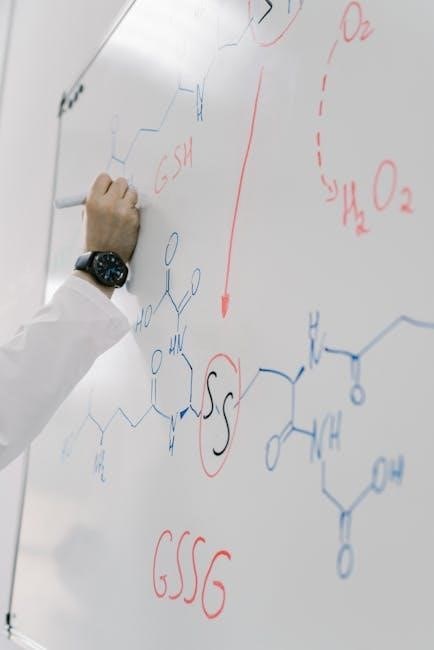
Answer keys for chemical reaction worksheets (often PDF format) are vital for self-assessment and identifying common errors in predicting reaction products.
Understanding Common Mistakes in Answers
When reviewing types of chemical reactions worksheet answers, particularly PDF versions, students frequently stumble on balancing equations before identifying the reaction type.
Incorrectly identifying diatomic elements or misapplying solubility rules in double replacement reactions are also prevalent errors.
A common mistake involves confusing single and double replacement reactions; careful attention to element switching is key.
Furthermore, students sometimes forget to balance the final equation after predicting the products, leading to inaccurate results.
Misinterpreting combustion reactions – failing to recognize oxygen as a reactant and carbon dioxide/water as products – is another frequent issue;
Thoroughly reviewing the answer key and understanding why an answer is incorrect, not just that it is, is crucial for improvement.
Using Answer Keys for Self-Assessment
Employing types of chemical reactions worksheet answer keys effectively transforms practice into a powerful self-assessment tool. Don’t simply check for correct answers; analyze how you arrived at your solution.
Compare your work step-by-step with the key, pinpointing exactly where discrepancies occur – was it balancing, product prediction, or reaction type identification?
If your answer differs, don’t immediately look at the solution; re-attempt the problem using a different approach.
Focus on understanding the underlying principles, not memorizing answers.
Utilize the key to identify recurring errors, indicating areas needing further study.
Regular self-assessment with the answer key fosters independent learning and builds confidence in tackling complex chemistry problems.

Resources & Further Practice
Numerous printable PDF worksheets and interactive online quizzes are readily available to reinforce learning about chemical reaction types and answers.

Where to Find Printable PDF Worksheets
Locating high-quality, printable PDF worksheets focused on types of chemical reactions is surprisingly accessible. Many educational websites dedicated to chemistry offer free resources, including worksheets with corresponding answer keys. Teachers Pay Teachers is a valuable platform where educators share and sell their created materials, often including comprehensive reaction type worksheets.
Additionally, general educational resource sites frequently host chemistry worksheets categorized by topic. A quick online search using keywords like “chemical reaction types worksheet PDF” will yield numerous results. When selecting a worksheet, consider its alignment with your curriculum and the level of difficulty appropriate for your students. Ensure the answer key is readily available for efficient assessment and self-study.
Online Interactive Chemical Reaction Quizzes
Supplementing traditional PDF worksheets with online, interactive quizzes provides a dynamic learning experience for students mastering chemical reaction types. Several websites offer engaging quizzes that test understanding of synthesis, decomposition, single replacement, double replacement, and combustion reactions. These quizzes often provide immediate feedback, helping students identify areas needing improvement.
Platforms like Quizizz and Kahoot! allow teachers to create customized quizzes or utilize pre-made content. Many of these platforms also offer detailed reports on student performance. Interactive simulations can further enhance learning by visually demonstrating reaction mechanisms. Searching for “chemical reaction types quiz” will reveal a wealth of options, often including self-grading features and answer explanations.
Advanced Reaction Types (Brief Mention)
While foundational worksheets and quizzes focus on the five main chemical reaction types – synthesis, decomposition, single replacement, double replacement, and combustion – it’s important to acknowledge more complex reactions exist. Acid-base neutralization, redox (oxidation-reduction) reactions, and precipitation reactions build upon these core concepts.
These advanced reactions often require a deeper understanding of electron transfer and stoichiometry. Exploring these topics after mastering the basics, using supplemental materials and PDF resources, prepares students for higher-level chemistry courses. Finding types of chemical reactions worksheet answers can help solidify understanding before moving on. Further study will involve concepts like reaction rates and equilibrium, expanding beyond simple reaction categorization.